Urban farm

FARMING INSIDE THE URBAN FABRIC

Huntington-Urban-Farm_Tim-Stephens_plusMOOD_View1-595x268

“The Huntington Urban Farm is to pave the way for fresh thinking in terms of how communities interact with each other and how a common, productive bond can be achieved through sustainable practices.”

New Zealand architect´s plan  for The Farm responds to the need for the sustainable practice of growing and cultivating one’s own food source locally. The farm provides the neighbourhood with convenient access to individualized plots of land where users can produce their own food right in the middle of the town. While the happy residents of the neighbourhood cultivate apple trees and grow tomatoes, lettuce, berries, herbs and decorative flowers in all colours on heir own farming plots, the architect Tim Stephens sees this as becoming more prevalent urban practice needing architectural urban planning solutions. As our population increases an urbanizes, urban farming will need good planning solutions.

Located close to the town’s active public centre, the Urban Farm project is comprised of farmable plots of different sizes to suit individual users/small families.  Big Huntington-Urban-Farm_Tim-Stephens_plusMOOD_Diagram-Site-Plan-595x763

Huntington-Urban-Farm_Tim-Stephens_plusMOOD_Typologies-595x407

Huntington-Urban-Farm_Tim-Stephens_plusMOOD_View5

This farm is viewed as a model that can be integrated into existing communities on other sites in different Long Island townships.  Within this particular design, the farm includes winding paths and changing levels to provide a “sense of adventure and discovery as one moves through the precinct.”  Stephens sees the design as promoting social interaction, especially with its converging paths which can lead users to happen upon one another while walking through the garden.

“The Huntington Urban Farm is to pave the way for fresh thinking in terms of how communities interact with each other and how a common, productive bond can be achieved through sustainable practices.”Huntington-Urban-Farm_Tim-Stephens_plusMOOD_View7

Huntington-Urban-Farm_Tim-Stephens_plusMOOD_North-Elevation

Huntington-Urban-Farm_Tim-Stephens_plusMOOD_East-Elevation  Huntington-Urban-Farm_Tim-Stephens_plusMOOD_South-Elevation

”In providing these farming plots for the community to use, the precinct will become a hub for social activity and interaction, something sorely missing in many existing communities.

via Archdaily

-aitoa

Venice rehabilitation project

History and modern design meet

Outside of Venice, Italy, a 19th century structure suffered from a fire, leading to the rehabilitation of the Campiello at Palazzo di Vigonovo by Venetian practice 3ndy Studio. The project’s completion gives the city a new location for social interaction while retaining an important part of the city. The space is brought back to life and its former glory.

cortenapartment01

The architects, by first tracing out the historical fragments and elements of a traditional lifestyle, make a connection to thre old history of the building. Double arched window openings now face a courtyard, standing in the place of the original building, commemorating without renovating the destroyed structure.

The sheets of paper which were scrawled upon in the studio during the brainstorming process, became a 300 square meter sculpture, made with 190 sheets of corten steel, reading as the page of a book. In collaboration with artist Giorgio Milani, the lettering is selected from 22 different alphabets. Following ‘footfalls echo in the memory’, the selection of diverse era fonts harmonize aesthetically and culturally into a graphic image. At night, illumination emanates through the patterned collections of voids.

Great photos by Fernando Guerra:

cortenapartment02

cortenapartment03

cortenapartment04

cortenapartment05

cortenapartment06   cortenapartment09

cortenapartment11

cortenapartment13

cortenapartment14

cortenapartment16 cortenapartment18 cortenapartment19 cortenapartment20 cortenapartment21 cortenapartment22

Project info:

architect: 3ndy Studio – Marco Mazzetto, Alessandro Lazzari, Massimiliano Martignon Architects
year of completion: 2011
address: via Veneto 5d, 30030 Vigonovo Venice, Italy
client: Cosmo immobiliare snc
gross floor area: 300 m2
façade artists: 3ndy Studio, Giorgio Milani, Philippe Daverio
photos: Fernando Guerra, Lisbon

Via DesignBoom

Art in Motion

Nick Cave soundsuits

Something to brighten the day up. Presenting (another) Nick Cave, the soundsuit artist:

Nick Cave´s soundsuits were featured at the Meet me at the Center of the Earth -exhition in Chicago. Soundsuits created by Chicago-based artist and professor, Nick Cave.

Cave, who considers himself a humanitarian before an artist, created his first Soundsuit in 1992, after the appalling discharge of police officers involved with the Rodney King beating. Originally created as a sculptural costume, Cave discovered it rustled to movement when put on- each creating their own distinguishable noise. Reminiscent of African and Caribbean ceremonial garb as well as haute couture, Cave’s Soundsuits examine themes of identity, transformation, ritual, and most specifically for this exhibition, spiritual strength. Cave also created animal totems to marry his human-based suits to the idea of power and peace, symbolizing communities that can co-exist despite great differences.  ..more

-aitoa

The Era of the Elderly

Live longer die faster Part 2.

-CASE VAASA-

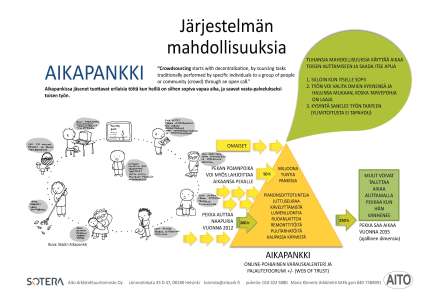
A lot of people want to participate doing things together with others. People want to show off their skills, to use the skills they have, and to feel part of a comunity or a society. But they want to participate on their own terms, and especially if thinking of elderly workers, in accordance with their own abilities.

Currently, in many cases, working conditions do not live up to this at all: timetables are stressed, flexibility is not allowed, and all tasks are based on a calculated profit, pushing the boundaries of what is ethical work outcome to its limit.  This often ignoring that making profit in developed societies with a fairly high living standard, starts from the people doing the work, and them feeling they are doing something they believe in, somewhat like, and that has a purpose.

The time bank offers means to exchange small tasks.

Crowdsourcing tasks is a way of offering people work opportunities on their terms. Anyone can participate, offer their skills to others, do the work when they have time and when they want to. In the other end you can choose from the tasks offered to you by others.

Could the use of crowdsourcing neighbourhood tasks be of help to the elderly?

Task can be crowdsourced by you and me and stored in a time bank to be recollected later.

-aitoa

Please mention the source, if using the presentation.

Live longer Die faster

Part one – The Era of the Elderly

In Finland we place our elders, to a larger extent than elsewhere in the world, in heavy institutions for care, care that can last for up to ten years. Institutional living that surpasses the EU recommendations is more of a rule than an exception. To tackle this, we have to harness architecture to make our cities liveable for the elderly.

Making our environments elderly friendly: with close-by daily services, small scale living areas and environments that act towards social interaction can save the country Finland approximately 1,2 billion euros a year.

Demographic change will make us face a new paradigm shift that could change our societies infrastructure dramatically. We will have to focus on small scale, close-by environments and services together with proactive and excellent rehabilitation for our elders to be able to cope at home with age.

Presentation from Seminar at Rakennusfooruumi “The Elderly, a strenght for society” 6.11.2012 (part 1.) in Finnish: link

Life long learning – sharing knowledge “Open School”

Open workshops where you can practice your skills and show others

Small workshops in the centers of urban areas

Places for lingering

Urban meeting places

Providing channels for people to gather around a common cause

Physical rehabilitation

Psychological rehabilitation

…and social rehabilitation

If used, please remember to mention the source of the presentation.

-aitoa

Solar nanoflowers

The next generation solar panels

Researchers from North Carolina State University have created flower-like structures that can make the use of  solar energy take leaps. These nanoflowers have extremely thin petals with an enormous surface area for maximum solar gathering.

Petals are made out of germanium sulfide (GeS) – a semiconductor material . The GeS flower holds promise for next-generation energy storage devices and solar cells.

“Creating these Nanoflowers is exciting because it gives us a huge surface area in a small amount of space,” says Dr. Linyou Cao, an assistant professor of materials science and engineering at North Carolina State University.

Link: ACSnano

Edible Infrastructure- Darrick Borowski, Jeroen Janssen, Nikoletta Poulimeni

Reblogged from FuturesPlus:

Click to visit the original post
  • Click to visit the original post
  • Click to visit the original post
  • Click to visit the original post
  • Click to visit the original post
  • Click to visit the original post
  • Click to visit the original post

Check out this project from a few students at The AA.  Done as part of an emergent technologies class, the few students created a new neighborhood, computational derived from the need for space and sustainability.  Although we would have liked to see some of the more important buildings have a more thorough design, the importance is in the larger scale of the urban fabric that is created. 

Read more… 300 more words

Interesting design on urban farming linked to city density. Hoping and looking forward to having realized, built projects like this. In the end, its only a matter of time, because cities in the world are growing with speed.

Solutions to the Helsinki housing shortage

Offices turned back into apartments

Helsinki, like many other cities, face problems on how to cope with the escalating need for housing in city centers. City planners raise their hands ” there are no building plots”, and in desperate cornered situations they cry out ” lets build sky scrapers”. The problem with this, is that sky scrapers cause urban pollution around them. Now we are not talking about smog or toxic microbes, we are talking about polluting urban space by bad planning decisions – the shadowy land around at the base of the high building that is out of human scale is not appealing to be, or to live in. The sky scraper pollutes the possibilities for good urban space around it. When building very tall, you are faced with need for a buffer zone around the building, a no-mans-land, taking away the argued benefit of inhabitant density of the area. Secondly, sky scrapers tend to in the end, despite nice arguments, be used for offices, not housing.

Keski-Pasila sky scrapers will face challenges in making ground level into city space for humans

When erecting a building construction, that will stand for at least 100 years and infuence many generations, it is a give and take equation inbetween building and society, not only a primitive transaction of squirrel skins. The building has to contribute to a better city space, not a worse one.

The natural two-way interplay between outside-inside, society-inhabitant is not present in very tall buildings above a certain height.

In order to find “plots” for our city planners, we took a look at what happened when we faced our last paradigm shift in urban planning during modernism/functionalism 1930-1970 and on. We say “on”, because these ideologies and ways of solving planning problems are still very present and utilized, when lacking better ideas.

Un-rational modernist planning

Modernist planning turned the city inside out: it segregated the city of mixed use into separate hermetic functions. It placed people in the suburbs outside the city centers, and brought offices into the city centers. Then people needed to get a car, in order to commute back into their old living areas downtown for work and activities. As a consequence, downtown faces problems to house people, because this roundabout traffic of people living outside center and commuting to activities inside, causes an exaggerated need for space for road infrastructure, parking and maintenance, while the outcry for housing in the centre is at the same time big, because the land is used for other functions than housing. In the same time the smaller businesses downtown have problems keeping up a viable economy when not having enough inhabitants around using their services. The whole modernist scenario of placing different functions: living, working, public service, culture etc apart from each other is in fact very unrational and uneconomical for society. Why waste so much resources, time and energy, on moving people from one place to the other when a balanced mix would be possible? Todays environmental needs to not wast resources makes the ideology even more outdated.

The new paradigm shift we will have to face soon, will bring overall resource use and life quality into the core.

Modernist mass movement of inhabitants

Helsinki city centre has lost half of its inhabitants during the years 1962-2012. In our chart we made 1962 = 100% (oldest to where we can find data), and in respect to that today we have only 57% inhabitants left in the city core. Part of this is because apartment houses has been turned into offices. So we calculated how much people could you house here, if you turned for example only the offices situated in nice old pre-1950´s buildings into apartments?

Possibility to double the amount of people living in Helsinki centre

We found, that Helsinki city core has almost 1,5 million square meters of pre 1950´s office space that could be turned into apartments. These are mainly offices that have taken over old residental buildings. With the average m2/person reported for Helsinki (2011), that makes housing for 42.000 people. As a comparison: Helsinki´s big building projects of the coming decades, Jätkäsaari and Kalasatama, will combined house about 37.000 inhabitants in total. In this possible scenario, we have left the offices in newer after 1950´s buildings as they are. If they are taken into account, the possibilities are even greater for finding suitable “plots for housing” in Helsinki city centre. It can be also noted, that due to the current economic situation in the world, there is said to be around 1 million square meters of un-used office space in Helsinki at the moment.

Amount of inhabitants in Helsinki city centre declined drastically during years 1962-2012. From the 60´s (100%) the amount if people housed in central Helsinki has halved (57%) to now a mere 59.000 people. By turning offices back into apartments (represented in Flesh Colour) we could house up to 42.000 more people in the city center, and bring city life up to par with other European cities.

This of inhabitants in reclaimed office space would pretty much double the amount of people that live downtown today. We would be back to the number of inhabitants we had downtown in the 60-70´s before the latest demographic shift, and Helsinki core would have around 100.000 inhabitants. That is still a small city, but it would have better potential for urban life. For a vibrant and interesting city life, economically viable smaller services and entrepreneurial innovations, inhabitants are essential.

Offices into exciting new apartments

These offices are easily turned into for example new loft apartments. Also within an often deep frame, social innovations of for example shared apartments for old people, communal living, and apartment adjacent au-pair rooms, live & work apartments etc, could be explored within this framework.

To conclude: “There is no shortage of possible housing plots in Helsinki, on the contrary there is a housing plot surplus. On the other hand, the problem might be a shortage of will or understanding to make things happen”.

-aitoa

Hufvudstadsbladet HBL: Sky scrapers like mushrooms

We used open data statistics from Tilastokeskus, Helsingin seudun aluesarjat and henkikirjat. The Helsinki central areas noted in our statistical study were:

091 10 Kruununhaka
091 20 Kluuvi
091 80 Katajanokka
091 30 Kaartinkaupunki
091 50 Punavuori
091 60 Eira
091 70 Ullanlinna
091 90 Kaivopuisto
091 204 Munkkisaari
091 40 Kamppi
091 130 Etu-Töölö

What if Planning focused on people?

Mannerheimintie IN HELSINKI for the People

What would happen, if Urban Planning focused on the needs of people, instead of the secondary needs of traffic, technical maintenance and political ideologies? How would we plan our cities if we planned spaces with the aim of spaces where people feel good, spaces that people want to hang out in, and visit time after time?

We analyzed briefly European cities to get a grasp of what draws people in to a city. After the bigger cities of London, Paris and Rome we have Barcelona, Amsterdam, Istanbul, Berlin, Prague, Venice, Madrid, Budapest, Florence on most wanted destinations. Close to the top are also cities like Split, Dubrovnik, Granada, Brugge and Riga. Do we visit these cities because we can travel fast in our car from one point to the other? Or because there are many huge shopping malls that sell the same global brands we can get in any other city (or buy online)? Or do we visit these cities because we want to admire the tall buildings and the “vibrant life” of office work? No, there are no sky scrapers in most of these cities. The city here we want to visit is low,  dense, surprising and the city has a character of its own, a character so thick it can almost be touched. The character of these cities can invade our private space, the flowers in the city can grow in places we normally would see as impossible, cars are much smaller than we would ever imagine, and the engineer in us says this kind of urban planning is not possible. Still, these loved cities draw year after year, millions of people who want to live there, to visit and to start businesses there, on this city´s own `impossible´ terms.


Urban Intervention on Mannerheimintie. Above: with an urban pool and vegetation focused on the pedestrian, and below: as it is today serving the traffic.

Based on these notions we made a quick, imaginary Urban Intervention Plan for Mannerheimintie, the main street in Helsinki centre. We thought: what if traffic would be restricted or moved? What if there would be more trees and green vegetation on Mannerheimintie? What if there was an urban outdoor pool for people, with sun beds, stairs you can sit on and dip your toes into the water, and refreshments served? What if the pool in crossed by many small pedestrian bridges? We also reckoned, what if we have entrepreneurial space for small businesses opening up to our street, and also mobile services allowed. Services that react to weather conditions changing the scenery depending on the climate of the day? We wanted a speaker´s corner with the best IT technology we have in Finland, harnessed for people who have something to say to the politicians inhabiting The Parliament at the edge of our Mannerheimintie. We wanted a wide pedestrian street opening up to open spaces like the Kolmen Sepän Aukio piazza, and it to have interesting things to follow while walking. This led us to that we need also non-commercial spaces next to our Mannerheimintie to bring the activity interest up.

Most of all, we need more people to inhabit Helsinki city centre and use our Mannerheimintie, so we need the offices, the traffic, and the un-rational  ideology that took our city in the 60-70´s to give it back  to the inhabitants of Helsinki.

An economically succesful city uses resources economically in a holistic sense, and looks at what attracts people. A succesful city is a network of places people want to explore, inhabit. People living, loitering, activating, changing, protesting, walking, meeting and not doing anything in a city are part of making a city.

We need to start planning our cities for people, instead of technically engineering them.

-aitoa

Most Wanted City Destinations List

Vilhelm Helander,  Mikael Sundman: Kenen Helsinki? p. 117 : in Helsinki centre 1970: the amount of apartment buildings or central blocks that are taken over by offices is huge.

More recent discussions on urban planning (Hufvudstadsbladet, in swedish):

HBL: Urban Planning has to become more humane (Architect Jan Gehl commenting on Helsinki and functionalist planning)

HBL: Helsinki Glass Architecture does not wow (London based architects commenting Helsinki)

HBL: Architecture has to create more value to an area (Swedish architect commenting on Helsinki/Töölö Bay area)

HBL: About the costs of traffic and parking downtown  (Architect Jan Gehl about Mannerheimintie and green politician Osmo Soinivaara on the high costs of building so much parking downtown)

HBL: Sky scrapers like mushrooms without public discussion (Architect Vilhelm Helander on high buildings)

Itä-Pasila – an Urbanistic Melancholia to be Salvaged

Make Helsinki PROJECT FOR Itä Pasila

Concrete, grey, empty spaces everywhere… Itä-Pasila needs colour, people, and plants to be all it can be. Where is everyone?

There is a certain sense that the largely immigrant population is shying away indoors, the students just there to sleep, and nobody else going there except by chance in passing to access the fair grounds or the public library. Why is this the perceived norm? My belief is simply that public space is unaffirmed and only a transit area.

There is an incredible potential here to turn the neighbourhood inside out, and gradually transform what many consider an architectural monstrosity into an inspiring icon of past utopias full of creativity as residents explore new directions for wrapping their collective identity around the detached urban fabric.

From MakeHelsinki.fi By Thomas Ermacora on 28/06/2012

MakeHelsinki.fi

Clear village.org